Cardio for fat engineers
It turns out I'm not terribly good at sticking to blogging on a regular basis, but I'm not going to let that stop me from blogging on an irregular basis at least.
My last post was in September - about 6 months ago - and plenty's happened since then. I'm very proud to be able to say that despite a slowdown over Christmas I've kept losing weight and I'm now near my goal weight. Consistently doing the thing works, it turns out. I'm now starting my "taper off" to reduce loss of muscle mass in the last few months as I try and get the remaining fat I need to lose gone.
Continuing on - some months later - let's talk cardio.
I've owned a rowing machine (a good, gym-quality one - a Concept2 model D) for years - and I've used it about three times a year on average. This doesn't, you'll be unsurprised to know, contribute massively to cardio health.
I've always enjoyed rowing as a motion and it's a great workout, but it has one major drawback - it's relatively hard to modulate, especially at the low end. If you're doing a row you're working at minimum quite hard, so you can't do it for very long at all if you're out of shape.
When I started planning how to lose weight and improve my health I figured I needed to work out how to make ongoing cardio improvement part of that. The rower got put away in the shed.
On yer bike
I decided to pick up a smart trainer for my (quite old) mountain bike - these are bits of kit you drop your existing bike on (usually replacing the rear wheel) and which use a flywheel and some method of modulating resistance to give you a software-controllable load to move. I did a fair bit of research and owing largely to already having the Garmin watch, figured I'd go for the Tacx Neo 2 - readily and plentifully available on eBay at "sensible" money. It's an electromagnetic flywheel so very quick to respond, and lighter to lug around; it's also well supported by all the apps (we'll come back to that) and has good sensors built in for stuff like power, balance, etc. The whole setup folds up nicely so when our gym turns back into a dining room the bike goes outside and the trainer tucks under a desk.
This did require me to get the bike working again, though. 10 years of very light use hadn't left it in great shape. It's not the right size for me any more, either - this was a second hand bike a couple of decades old, bought when I was a fair bit smaller - so it is getting replaced at some point with one that fits me. It's a Trek 3700 - a decent starting point.
(It's worth noting you can buy a "trainer bike" - an adjustable frame you drop on a smart trainer; this isn't that much more expensive if you're having to refurb a bike or buy a new one, but they tend to be less flexible and obviously anything you spend on them only helps your indoor riding setup)
I ended up replacing the chain, rear gears, handlebar grips (with some Ergon palm-and-upright style ones), and saddle, plus doing a bunch of maintenance tasks - cleaning, regreasing things, etc.
One important note is that if you're pedalling around your local area for short periods a comfy saddle is fine. If you're going to do a lot of pedalling, though - for hours on end - then it turns out you need comfy clothing and a relatively firm saddle. I learned this quickly, bought some plus-size bib shorts with a pad from Cycle Wear Central (home of "Fat Lad at the Back" designs), picked up a Fizik Argo saddle from eBay, and that worked alright - it's much comfier than a padded saddle and light shorts, for instance.
This principle also applies to pedals - you'll want to be clipped into cleats for the longer rides. I bought some Fizik Vento Proxy shoes and some Shimano SPD pedals (which still have a deck for non–cleat usage) these are well ventilated and so comfy for endurance riding. There are loads of different cleat types but for indoors it's worth noting SPD are one of the few which you can walk around in without ruining your floors.
You'll also rapidly find you want a towel, at least one good quality fan (I went with the VacMaster Cardio 45, which everyone recommends - and with good reason), and a water bottle. Depending on where you're putting the bike, you might also need a trainer desk or some other way of putting a laptop/screen at eye level in front of your bike.
Apps and motivation
I mentioned apps earlier - this is where the "smart" bit of the smart trainer comes in. The Tacx trainer comes with an app and you can pedal along to some videos, with some syncing up between video and resistance. This works, and is cheap/free, but my AuDHD brain needs more interest than this to stick with something for an hour.
Zwift is probably the best-established smart trainer app out there - it's a MMORPG you play by cycling or running on a treadmill. I say it's a MMO because you're cycling in a shared virtual world with lots of other people, and an RPG because you level up by cycling, unlocking new bike upgrades, cosmetics, and so on.
More importantly though, it has lots of groups and clubs - so you can ride together with people and get to know them. It turns exercise in your home into a social activity. There's chat. Now AuDHD brain has something to turn up for.
I started off with a simple rule: every week I'd make it to the LGBTQ+ Wednesday social ride, and I'd ride with that group for 45 minutes. It's an easy ride - rubberbanding keeps the group of riders together regardless of individual efforts so if I'm not feeling great I can take it easy but if I want to I can increase the gear ratio and push harder.
Most weeks I've also managed to get on the bike for another 45 minute session some other time in the week.
For about four months I also used TrainerRoad to define workouts - it works, but only if you stick to it pretty reliably, and only if you're doing longer sessions (at least an hour). It can sync with Zwift so you can do virtual workouts - with TrainerRoad's defined resistance/time pairings on a Zwift "route" through a virtual world. This works very well in terms of structuring your workouts.
In the end I found these much less engaging and stopped doing them in favour of just riding routes. Progressing through the Zwift world gets very slow if your workout calls for a 60W endurance step whereas you'd be pedalling 120W for a bit of uphill in the route - and TR ended up recommending lots of low-power endurance work for me.
Impact and recovery
Cycling indoors has the great feature, compared to the rower, that you really can dial it down if you need to do an easy ride. If you want to aim for zones 1-2 for an hour you can just sit there and make that happen with no drama; if you want to pick up some zone 4-5 it's easy to ramp the difficulty for a spell. This is excellent as an exercise form for recovery. It's also much easier on your joints than, say, running.
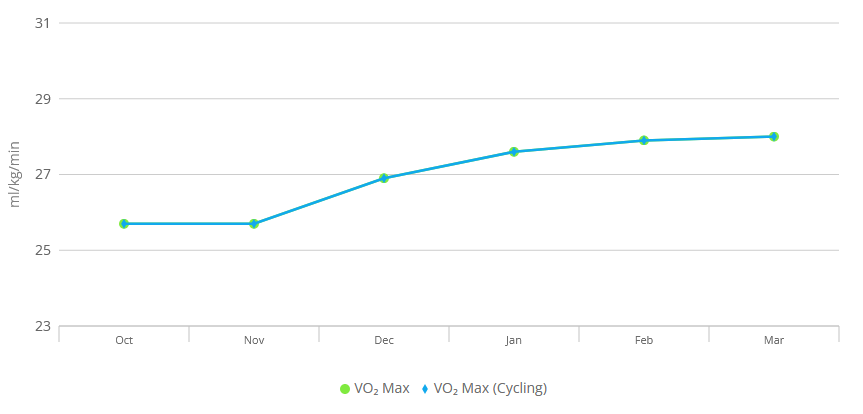
My cardio fitness is absolutely still trash - I'm still on 1300 kcal per day food intake, and that's not a lot of energy to work with when exercising. It's also probably the case that my muscle loss in this cut will in part be affecting my heart muscle.
However - as the chart shows above - it is improving a bit. And it is definitely the case that I can go for longer and harder than I used to when I first started. Before I started cutting calories significantly my FTP - the power output I can deliver "continuously" without fatiguing/hitting lactate threshold - was about 350W. I'm down to 130W at the moment on a good day. But when I start returning to "normal" calorie intake I should be able to get back up to higher FTPs pretty quickly, in theory.
There's obviously a little calorie burn benefit in terms of fat loss, but it's not huge - it adds up if you're doing a lot in a week (e.g. 3 sessions of 45 minutes to an hour can be around 1000 kcal of active calories) - but the fact that you get some muscle building/retention benefit and good cardio benefit is a really nice combination.
So as long as I keep doing this, I'll make improvements, and eventually get to where I want to be.
Other apps and the outdoors
I've been tinkering with other apps - not for features but just because my attention span is crap and "new shiny" can sometimes help motivate.
Rouvy is the only one I've found quite good as an alternative to Zwift so far - I've not used it much but the basic function is like Zwift, but on "real world" routes with video used as the basis for the display. The upside of this is you get to see interesting places around the world and it's a nice change from the cartoon virtuality of Zwift.
My ambition is to get to the point where I'm confident enough in my fitness I can go for some rides on the roads and tracks near home; I'm only 45 minutes of road and gravel track away from our local Big Shops, so eventually I'd like to be able to do this regularly as some exercise while getting something done (e.g. a weekly shop). But to do this I'll need to buy a new gravel bike, some panniers, and so on.
It's a nice thing to aim for in the long term! In the meantime, the indoor route is doing what I need, so I'll stick with that till I've finished tapering off my Mounjaro and am back on maintenance calories.