Actually eating less
So with the support of GLP-1 RAs and GIPs, I could eat less. Had to, to avoid nasty side-effects like vomiting etc. So how to go about it in a reliable, consistent way that works with a high-stress, time-poor week, as a confused audhd engineer?
Making eating less the easy option
In my mind the only way I was going to end up eating less reliably was to make doing that easier than any other option. So easier than takeaway, easier than opening a cupboard and snacking, easier than big, calorie-dense ready meals. My brain will default to easy stuff at the end of a day; and if I'm working through a day with lots of calls I need to be able to turn lunch around (or at least get it on my desk) in 10 minutes. Yes, that part is probably not helping the stress, but it's reality, and it's hard to change quickly. Start with the mutable.
Looking at outputs, the important stuff on day one was simple: calories. Macronutrients are important to get right, too, but less was the important starting point.
How much less is the question.
I can't remember whose diet guide I read years back but they'd taken a very mathematically simple model to dieting - 1kg of fat is (broadly speaking) 7,000kcal of energy. If you can make your body consume that energy from stored fat instead of providing that energy through external sources, you will lose 1kg of fat/weight. Turns out this is about right, though the exact fats vary in terms of energy content so it's a number between 7,000 and 10,000. But ballpark, let's use 7,000 as a target.
I want to get healthy fast, so I'm aiming for at least 1.5kg of weight loss per week, or about 6kg a month. This means I need to put 7000*1.5/7 = 1500 kcal less into my body than I use every day, at least.
Starting this, I'm 6'4", 34, and about 128kg. Lying in bed I burn around 2800kcal, in theory and according to a bunch of basal metabolic rate calculators. So to reliably hit my deficit I need to eat no more than 1300kcal per day.
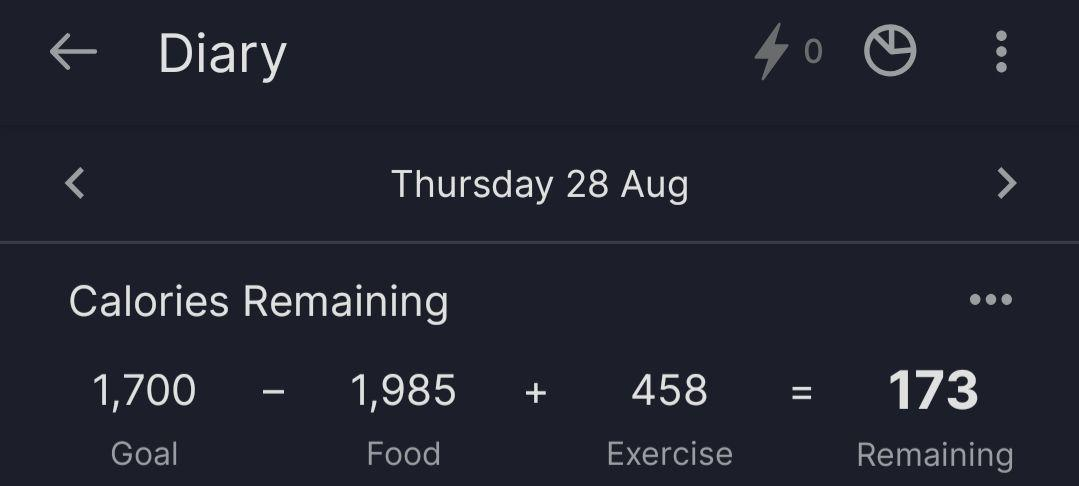
At the outset this seemed pretty implausible to me. I'd tried restricting myself to 2000 a day in the past and struggled. I had been using MyFitnessPal to do the calorie logging, but this also syncs down my Garmin's active calories estimate - how much you've burned beyond your BMR - and offsets your target. So I was still really eating more than that. So I split the difference for month 1 and aimed for 1700kcal per day, which will still lose me some weight but is less aggressive.
Cooking for 0.35
Then we have the question of making this easy for small portions for one.
Breakfasts I've been making very easy for a long time out of sheer laziness - I buy crates of Huel ready-to-drink and those are my breakfast. It's an expensive route - you can buy the powder and mix it which is much cheaper - but it works, is reliable, is 400kcal of pretty decent nutrition every day, and there's enough flavours to not get too bored.
Microwave meals are trivial to prepare quickly, but buying ready-made things didn't appeal; so I figured I could make some curries and dals in bulk, and freeze appropriate portions, ready to throw in the microwave and eat, with some greens and maybe a from-frozen chapati on the side. Working out quantities and volumes on some spreadsheets, I figured that between 250 and 300mL of stuff was about right for a 350-400kcal meal - about where I needed to be. That holds true for most proteins - lamb, chicken, pork, fish - and most dals (though it's on the small side for most dals - you need more volume to hit >350kcal).
Pyrex do a glass dish with a plastic sealing lid that is 350mL in volume, fully microwave safe, stacks, and I could fit plenty of into the freezer. I bought 12 and another 12 a week later. They're my meal containers now, and once I've done my cooking, I have 24 meals in the freezer. I take "have got ~10 clean ones in the cupboard" as my trigger to make more.
Batch cooking really is just a bit more work than making a meal, and there's lots of tricks. I'll share a few recipes in a separate post and talk about what I've optimised for ease of prep, what's worked well, and so on. To sum up the menu for the last two months:
- Lamb and turkey keema
- Red sri lankan style chicken curry
- Masoor dal with basa fish
- Moong dal with chilli and yogurt
- Lamb bhuna
- Chicken thigh bhuna
- Chicken manchurian with basmati
... all with sides of (bought frozen, Shana brand) chapati (~125kcal, so not too often) and/or some coarsely shredded cabbage sauteed with turmeric, English mustard and mustard seeds, which is my routine vegetable side (about 35kcal). I'm not terribly good with vegetables unless they're stir-fried or potatoes, but this hits the spot for most curries, two portions fit in a tiny 3-for-£2 IKEA glass tupperware for freezing, and it requires no reheating or prep from the fridge - just a spoonful goes in the container after cooking. There's a lot of vegetables hidden in most of these recipes, too - the keema is full of chickpeas, peas, peppers, and spinach, for instance. Mostly I'm biasing stuff in favour of having lots of protein in and not so much fat or carb, to try and minimise muscle mass loss.
My rule is that I need to be able to produce 8 or so portions easily in an afternoon of cooking - ideally a couple of hours tops - and I spend a few hours each Sunday doing my cooking for the next week.
It is really nice to not have to constantly be cleaning up in the working week, as a side benefit - the kitchen's a mess by 3pm on Sunday but cleaning that up once is all the effort it takes for the week; daily meals just go in the dishwasher immediately. That's helped the stress all by itself. Having Sunday be the day I do cooking also gives a nice bit of structure.
My wife often jokes that I'm now constantly cooking Indian and she's rarely cooking her own cuisine. We agreed that for the next year - however long this takes - I'll be eating my own smaller meal pots for most meals, but we still plan one or two shared dinners through the week which work calorie-wise for us both; things like prawn stir-fries and trout with broccoli, both of which weigh in around 500-600kcal - a bit heavier, so I just plan for a lighter lunch those days.
Budgeting
Armed with a couple of numbers - 1300-1700kcal to eat per day to lose the right sort of weight per week - I started out alright and was using MyFitnessPal, a freemium app for calorie counting.
I was losing about 1kg a week targeting 1700 but I was also adding in between 200 and 800kcal from my Garmin, which feeds "active calories" back to MFP. That measure is pretty inaccurate so I'd only ever eat about half what Garmin thought I'd won back. Even so I needed to be eating less. Intuitively it made sense I could eat more on days I did more but I often ended up over 2,000kcal. I was still losing weight but it wasn't as fast as I wanted.
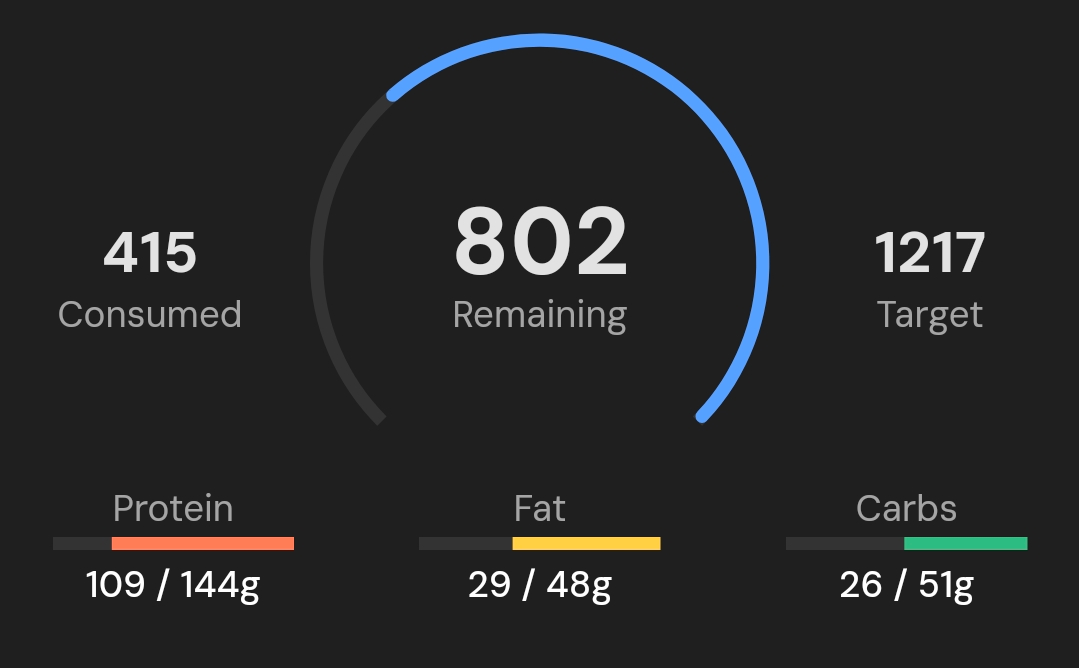
I swapped to an app recommended by my mum (longstanding health nerd and endlessly supportive), Macrofactor. That takes a different approach - you log your weight and your inputs (food) and it tries to estimate your TDEE (total daily energy expenditure) as an averaged figure over time. You then get a calorie budget that's built off the target delta - repeating that calculation above, basically, but off "actuals".
That's worked really well so far, and I'm managing about 1.75kg/week on my current plan. I am struggling to hit my protein goal, though - the app also gives you macronutrient breakdowns and targets (hence the name). But it is right that I should be having more given my exercise. It feels a bit odd - on longer days I tried not to eat any more - but after a few weeks it's arrived at a reasonably sensible daily goal (1270 on "rest" days, 1350 on "workout" days), which I mostly hit.
So I'd avoid MFP, or at least not attach it to any fitness trackers, and stick to a fixed number. Macrofactor seems a pretty solid choice as an all-round tracking app - it's commercial, but the UI is well thought through. You also get lots more detail - especially if you use their "common" food database this includes tons of micronutrient detail which can be helpful to see.
It's also worth noting that these numbers will all vary over time - which is why tracking intake and weight is important over time. Exactly what you lose in the way of tissue mass (i.e. muscle vs fat) will vary your BMR differently. Estimating what tissue you're losing is basically impossible so just measuring inputs and results is the way to go.
As an aside - if you're doing this a smart scale is so worth it to eliminate admin hassle and - depending on model - get some indication of e.g. body fat % vs muscle/water (using bioimpedance analysis). I'm a huge fan of my Withings, which I've had for about 10 years, Just Works, and still only needs a battery charge every 6 months; it syncs to Android Health and other services natively (including MacroFactor through Android Health). Garmin have smart scales but I've heard mixed reviews.
Basically, it's generally worth investing in tools to make life easier around the admin and remove any friction from the process of getting the data into the right place every day, I find.
Lazy sysadmins are the best because they'll automate everything, goes the old saying. Lazy sysadmins trying to get fitter can automate a lot of health and food data collection, so why not? (Cost aside - I am in the privileged position to not worry too much about that)
Next up... cardio and weights
Now, if you just rapidly lose weight by not eating much, one of the side effects of that is that not only do you lose fat, you tend to also lose muscles. Eating a high-protein diet will help with that, as will some supplements, but exercise is also a necessity to stave off losing all your strength.
I also need to work on my cardio, having never really done any, so my heart doesn't just give up in a decade or two.
So that's the next blog post - stay tuned.